
Reuters Pharma Customer Engagement 2025: 5 key Takeaways Driving Pharma Success.
Authored by: Danielle LaBraico, Mike Zapiec, Steve O’Kane
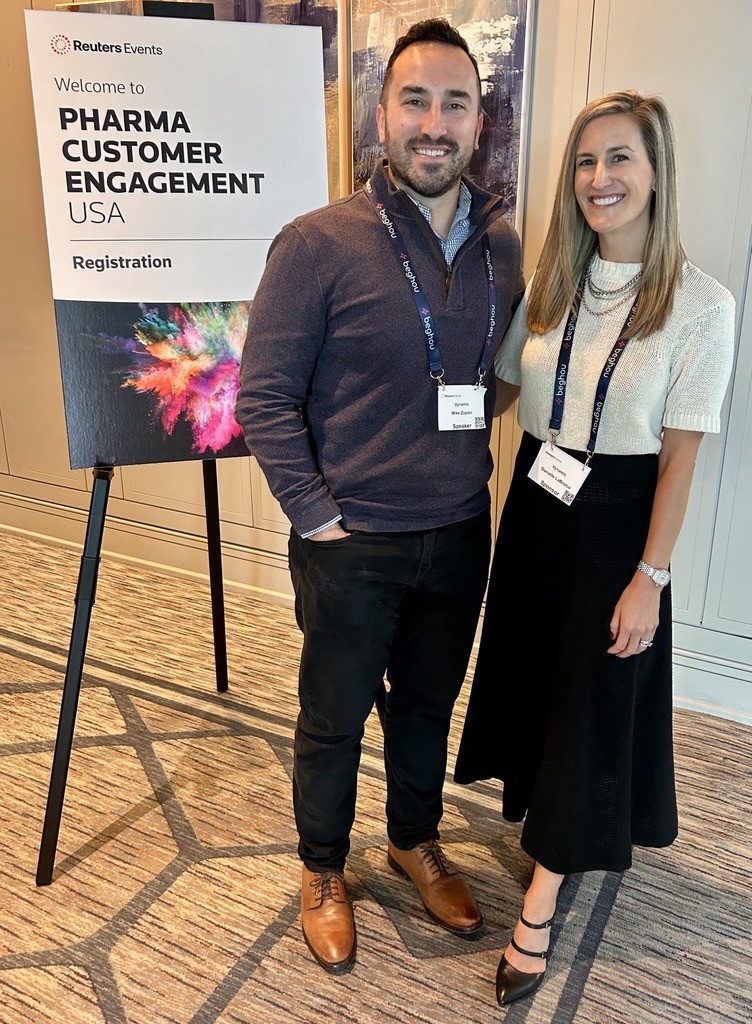
We had the opportunity to join industry leaders at the Reuters Pharma Customer Engagement conference in Philadelphia, a gathering that brought together some of the most forward-thinking minds across commercial, medical, and market access teams.
While the sessions spanned a wide range of topics, several themes emerged that reflect where the industry stands and where it’s heading. Below is a summary of key takeaways that stood out to us.
1. Experiment Boldly with AI – But Stay Grounded in Purpose
AI is everywhere; and everyone is experimenting. Agentic AI took center stage, with leaders sharing use case examples ranging from logging sales calls for reps, orchestrating customer journeys, and serving as navigators on brand websites to “serve up” the right content on demand.
What’s clear is that AI alone doesn’t deliver success. It’s not about deploying the next tool, but about aligning technology with real business challenges. The companies seeing traction are those asking, “What problem are we solving?” before asking, “What can the tech do?”
To maximize AI’s potential, it must be purpose-driven, not just tech-driven. Tools like LaunchNav help teams prioritize with precision, focusing on what truly drives launch success.
2. Make Change Management a Competitive Advantage
What was once a “nice-to-have” has become a non-negotiable. At this year’s event, change management received just as much airtime as AI, underscoring its critical role in pharma transformation.
Even the most advanced omnichannel and AI strategies can falter if the people who need to activate them aren’t aligned for success. The differentiator isn’t the technology itself, but how well organizations help their teams adapt, connect, and collaborate across functions.
Successful change requires clarity of purpose, investment in upskilling, and the creation of psychological safety for experimentation. Transformation doesn’t fail because of technology, it fails when people aren’t prepared and empowered to succeed. The organizations that prioritize culture, confidence, and communication are the ones turning pilot programs into scalable capabilities.
3. Balance Innovation with Simplification
Many teams are moving fast to innovate, rolling out new capabilities, platforms, and pilots at a rapid pace. The intention is good, but the result can be noise and inertia that impede success. Sometimes the most impactful solutions are the simplest ones.
One speaker shared how a team solved a patient adherence issue not with a new technology, but with a simple human fix: telling patients to expect a call from an unfamiliar area code to schedule their medication setup. It’s a reminder that innovation doesn’t always mean “digital,” it means solving the real problem in the simplest way, while keeping the patient at the center.
4. Prioritize with Intention
There’s a growing need for focus. Many organizations are trying to do more with less (a familiar refrain) while chasing the next wave of innovation. Teams are stretched thin, making incremental progress across too many fronts and struggling to measure impact.
The path forward requires strategic prioritization: looking holistically at the business to identify the key initiatives that will truly move the needle. A good way to do this is by developing a clear, enterprise-level roadmap outlining the capabilities you’re building now, next, and later – and just as importantly, articulating what you’re not doing. Get the basics right. Ensure foundational capabilities and tools like clear messaging frameworks, segmentation, roles and responsibilities, and content strategies are in place before layering in advanced capabilities.
5. Lead with the Business Problem
The consistent takeaway from both the conference and our work is technology should follow purpose, not lead it. Whether the goal is improving patient adherence, deepening HCP engagement, or enabling smarter content delivery, success starts with a clear business problem and ends with empowered people driving meaningful (and lasting) adoption.
Final Thoughts
We all know that technology will continue to advance, but to optimize uplift and impact, the life sciences industry needs to sharpen our focus on the purpose behind it to drive transformation at scale.
At Vynamic, we help life sciences organizations bring clarity to complexity, combining strategy, experience design, and change leadership to turn ambition into action.
About Vynamic
Vynamic, an Inizio Advisory company, is a leading management consulting partner to global health organizations across Life Sciences, Health Services, and Health Technology. Founded and headquartered in Philadelphia, Vynamic has offices in Boston, Durham NC, New York, and London. Our purpose is simple: We believe there is a better way. We are passionate about shaping the future of health, and for more than 20 years we’ve helped clients transform by connecting strategy to action.
Through a structured, yet flexible delivery model, our accomplished leaders work as an extension of client teams, enabling growth, performance, and culture. Vynamic has been recognized by organizations like Great Place to Work and Business Culture Awards for being leaders and innovators in consulting, company culture, and health. Visit Vynamic.com to discover how we can help transform your
organization or your career.
Want to learn more? Get in touch!
Other insights.
Jump to a slide with the slide dots.
We’re Gold Sponsors at Reuters Pharma Customer Engagement USA 2025
Join us Oct 28 at Reuters Pharma USA 2025 as Vynamic leads a CX panel with Pfizer, Takeda & AstraZeneca on scale, stability & innovation.
Read moreVynamic Appoints New Head of Life Sciences Europe to Drive Strategic Growth & Innovation
Vynamic appoints Gemma Pfister as Head of Life Sciences Europe to drive strategic growth and innovation.
Read morePMLive interviews Vynamic product launch service lead, Ashley Stanley
PMLive interviews Vynamic's Ashley Stanley on the key imperatives to ensuring launch success in a post-pandemic market.
Read more